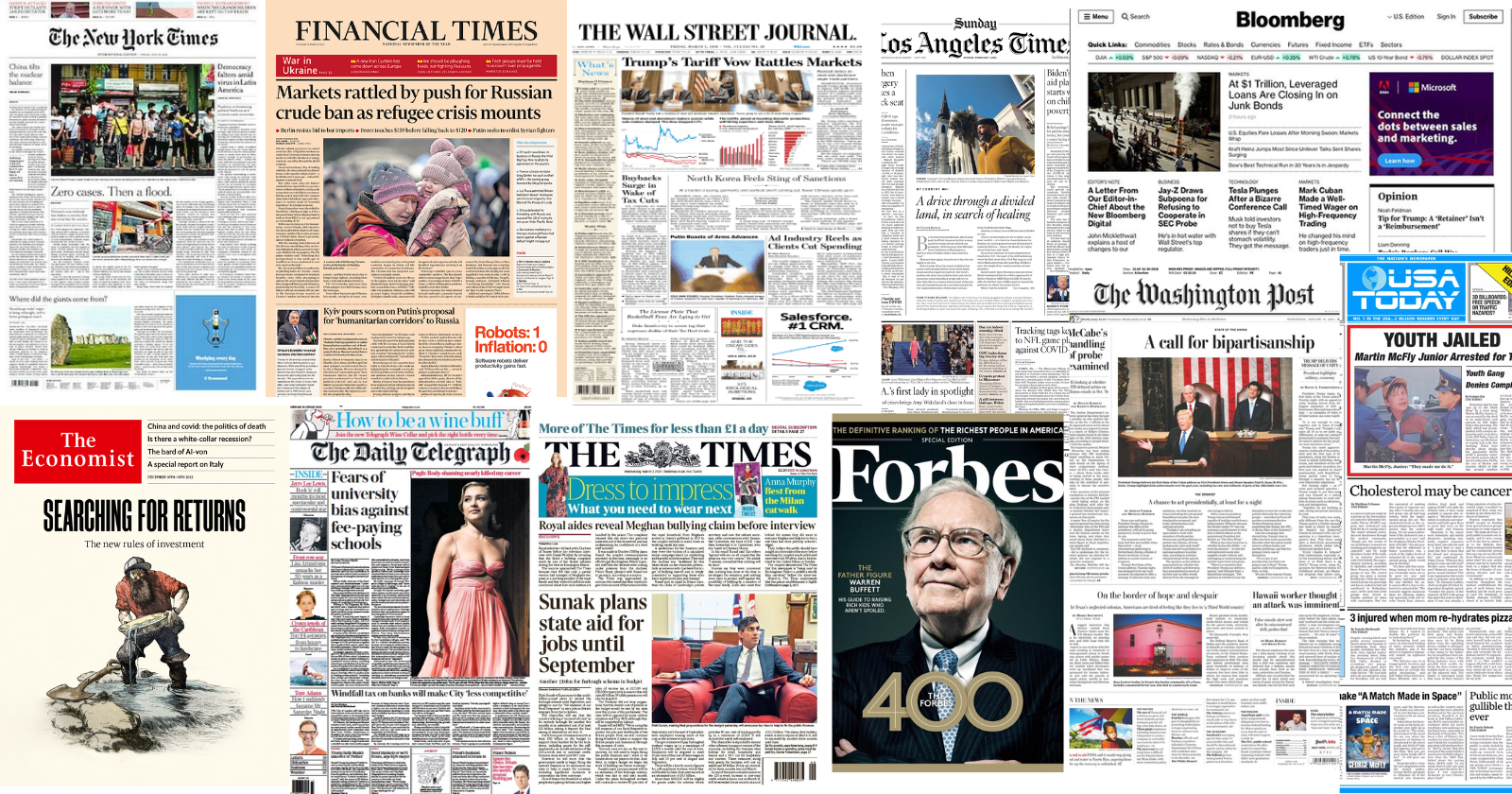
As a smart investor, we will have to keep on track with the current financial information so that we will make money in the market or in our business. Here we list the Top 10 financial newspapers & magazines for your reference.
1. Wall Street Journal
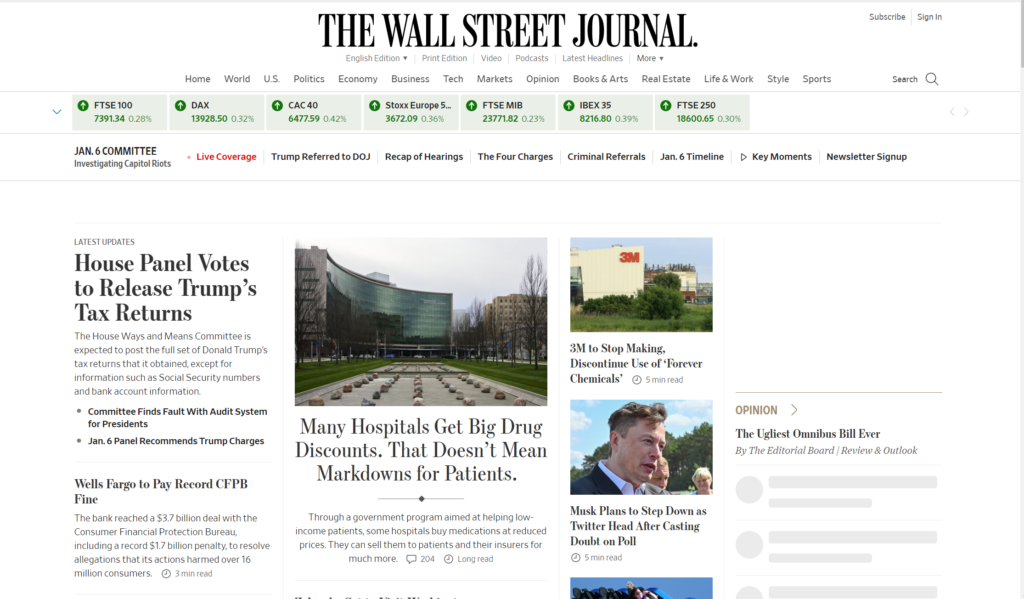
The Wall Street Journal, founded in 1889 and owned by Dow Jones & Co. and acquired by News Corporation of America in 2007, is a general newspaper featuring financial coverage with a wide international reach and enough content to influence daily international economic activity, and is the largest financial newspaper in the United States in terms of paid circulation.
The Wall Street Journal is serious in style, with fewer photo stories and a very careful choice of topics. Readers of The Wall Street Journal are mainly politicians, economists, educators and medical professionals, financial tycoons and business executives, as well as investors in the stock market. The vast majority of managers of the 500 largest companies in the United States subscribe to the paper. In addition, Asian, European and online editions are published, with a daily readership of over 10 million.
Pros
The Wall Street Journal digital edition is one of the biggest online subscriber-based services. So if you are looking for an excellent go-to financial resource, the digital WSJ could be precisely what you’ve been looking for in an app.
The WSJ mobile app is easy-to-use and makes it simple to access the current and back issues of The Wall Street Journal from any computer, tablet, or smartphone.
Ask nearly anyone, “Is the Wall Street Journal reliable?” and you will get a positive response.
The WSJ is a financial publication, as well as a daily newspaper. It includes hard-hitting journalism, financial news, opinion pieces, and entertaining articles.
Price is on par with other popular financial publications that do not offer as much content as the WSJ.
You can access the archived articles, which can be helpful for research purposes.
Discounts are often available for new subscribers so that you can try them out with less investment.
Adding the print version to your subscription is quite affordable.
Cons
The Wall Street Journal costs are notable, and even your first article each month is behind a paywall.
Like any newspaper, there may be an opinion piece or some articles you disagree with, and you may feel that the paper leans one way or the other politically.
Cancellation is not easy. You will have to call to cancel if you decide that the subscription is not for you.
Subscription Price: Digital Edition: $467.88/year
2. Financial Times
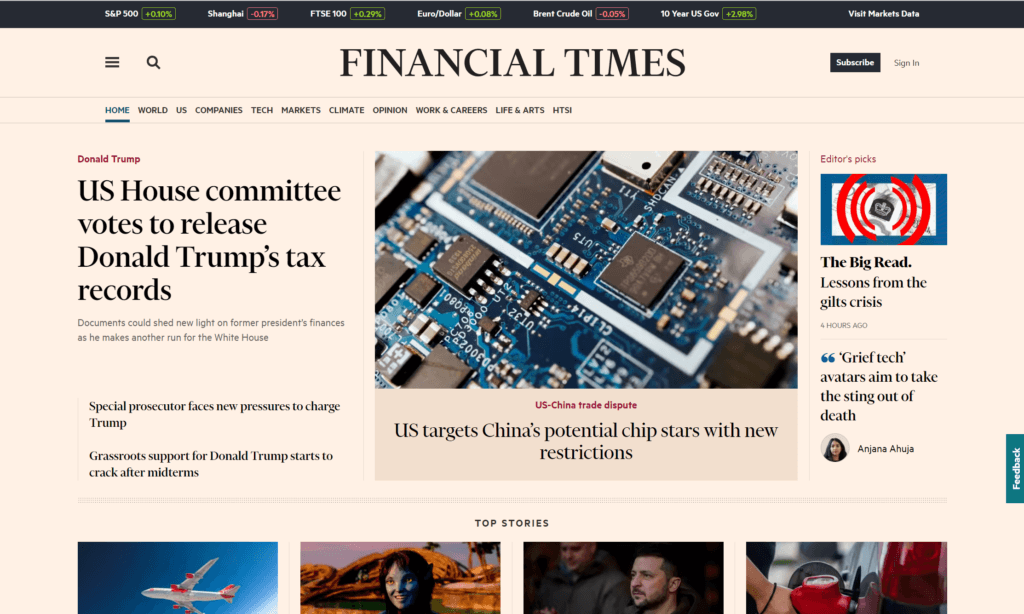
The Financial Times, part of the Pearson Group, is headquartered in London, England. 100% owned by Nihon Keizai Shimbun in Tokyo, Japan, the FT is a leading global financial newspaper, focusing on providing readers with global economic and business information, economic analysis and commentary, with four print editions in the U.S., U.K., Europe and Asia, of which 70% is distributed in more than 140 countries outside the U.K., with a global readership of more than one million. A wide range of articles cover business, finance, economics and other areas.
The Financial Times focuses on business and financial news, and details daily stock and financial commodity prices. The Financial Times Group also has offices around the world to provide first-hand coverage of local current events. The Financial Times is generally divided into two main stacks. The first stack focuses on global current affairs, while the second stack provides detailed coverage of local business and financial news. The Saturday edition of the Financial Times has special sections on culture and arts events.
Its well-known brands include: London Stock Market Financial Index, World Top 500 List.
Pros
- Incredible resource for the senior financial decision-makers and investors
- Unlimited access to digital channels at your convenience
- Access to ePaper along with the digital subscription
- Excellent perspective on the economic, financial, and business news from around the globe.
Cons
The price is too steep, the most expensive newspaper in the world.
Subscription Price: Premium Digital: $629/Year
3. Bloomberg News
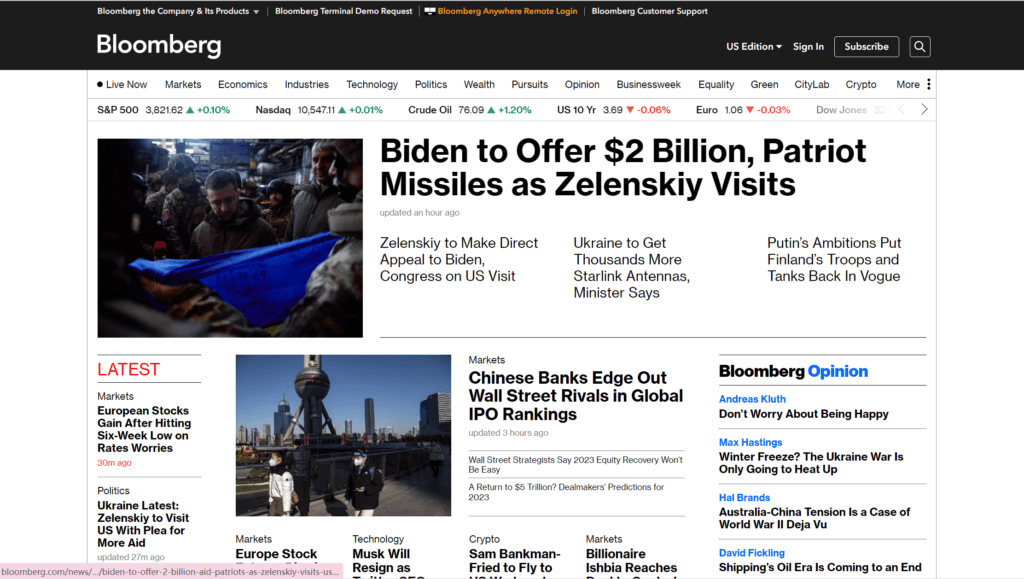
Founded in 1929, Bloomberg Businessweek is a leading global business magazine, originally published by the McGraw-Hill Group, and since 1988, Businessweek has published annual rankings of U.S. MBA programs. In 2009, it was sold to Bloomberg and officially renamed Bloomberg Businessweek.
As one of the most influential weekly magazines in the country, Bloomberg Businessweek is recognized as the most authoritative English-language business magazine, a provider of core global business information and knowledge to help you find the key to success in the modern complex economic society, with in-depth analysis and coverage of today’s technology, finance and management trends, and accurate and professional analysis and forecasting to win the trust of business people from all walks of life. With a focus on news, foresight, depth and perspective, we serve readers in the new global economy with insight and interest. With more than 2,300 news and multimedia professionals at 146 Bloomberg locations in 72 countries and territories, and a top-notch local editorial team, Bloomberg delivers insightful, original business reporting to serve readers in the new global economy.
Subscription Price: Digital Access: $299/Year
4. Barron’s
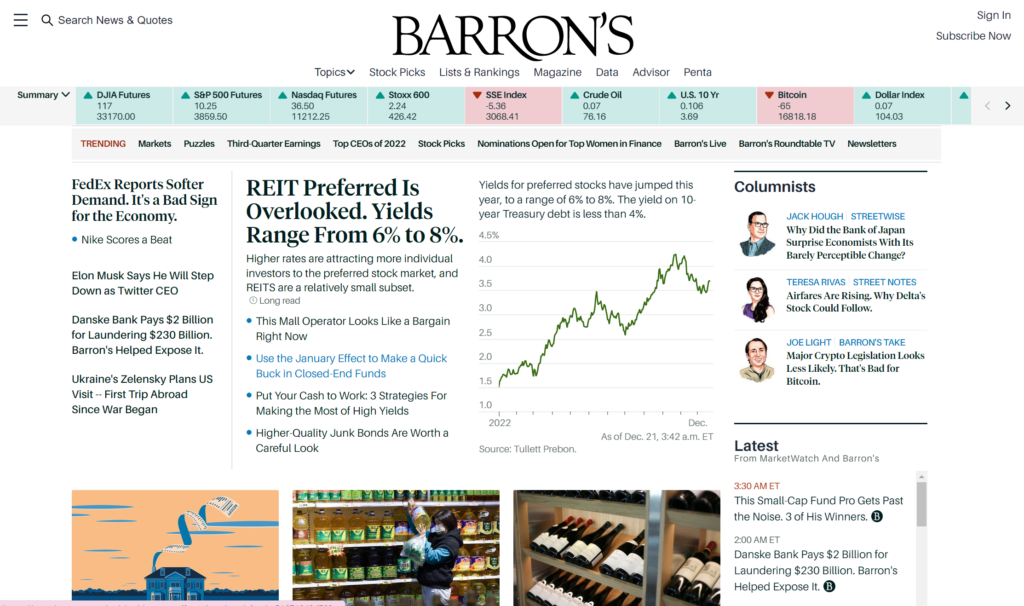
Founded in 1921 and part of the Murdoch News Group, the Barron’s is a professional financial weekly magazine focused on helping U.S. professional institutions and investors grasp the direction of financial market development with accurate judgment and thorough analysis. The publication reports on U.S. financial information, market developments and relevant statistics. Each issue provides a summary of the previous week’s market activity, news, reports and an outlook for the following week.
Barron’s is owned by Dow Jones, along with the Wall Street Journal, from which many of its editors are drawn. Barron’s takes most of the strengths of the WSJ and removes most of the weaknesses of the WSJ, especially in its focus on market trends and investment management issues, while leaving political topics largely unexplored. Because it only publishes one issue per week, Barron’s discusses fewer timely topics and more in-depth commentary and background information. Its op-eds are a step above the level of the Wall Street Journal.
Pros:
- Large inventory of articles
- Expert stock insights and analysis
- Access to a mutual fund screener
- Sleek and user-friendly website and app
- Solid customer support
Cons:
- No charting or technical analysis tools
- Not beginner friendly
- No support for portfolio analysis tools
Subscription Price: Digital Access: $173.88/year
5. The Economist
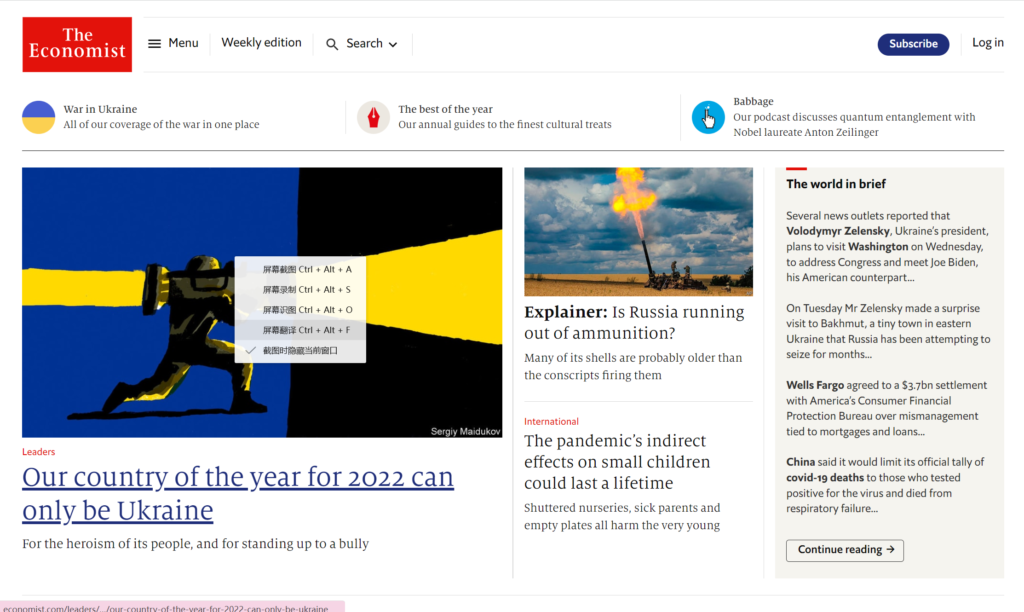
The Economist is a magazine published by the British Economist Group, founded in September 1843 by founder James Wilson. It is an international weekly news and business magazine that provides clear coverage, commentary and analysis of global politics, business, finance, science and technology, as well as related coverage of technology and the arts.
The Economist is not a traditional news outlet, but rather focuses on current analysis and insight into future trends, so if you want to know what’s going to happen in the world soon, read The Economist. Most of the magazine’s articles are written with wit, humor, intensity, seriousness and humor, and focus on how to tell readers the most in the least space, making it one of the most widely read current affairs magazines in the world.
The Economist differs from other publications in that its articles are published anonymously. The collective voice and identity are far more important to The Economist than the individual identities of individual journalists. Each week, The Economist is read by more than 4 million readers in more than 200 countries around the world and is recognized as one of the world’s most influential political business journals. In addition, The Economist has columns on the US, Americas, Asia, Europe, Middle East/Africa, UK, and China.
Pros and cons of The Economist subscription
Pros of The Economist
- It can be accessed on multiple devices and have a beautiful UI (User Interface).
- New Weekly updates of articles on various niches.
- A great way to increase your knowledge of anything you love.
- They have higher numbers of positive reviews.
- A huge chunk of readers loves to read The Economist daily.
Cons of The Economist
- The subscription cost of The Economist is slightly higher than other digital magazines.
- Then the finance and economics section is a little too tricky for those who don’t have any knowledge in this field.
Subscription Price: Digital Edition: $199/Year Annual pay.
6. New York Times
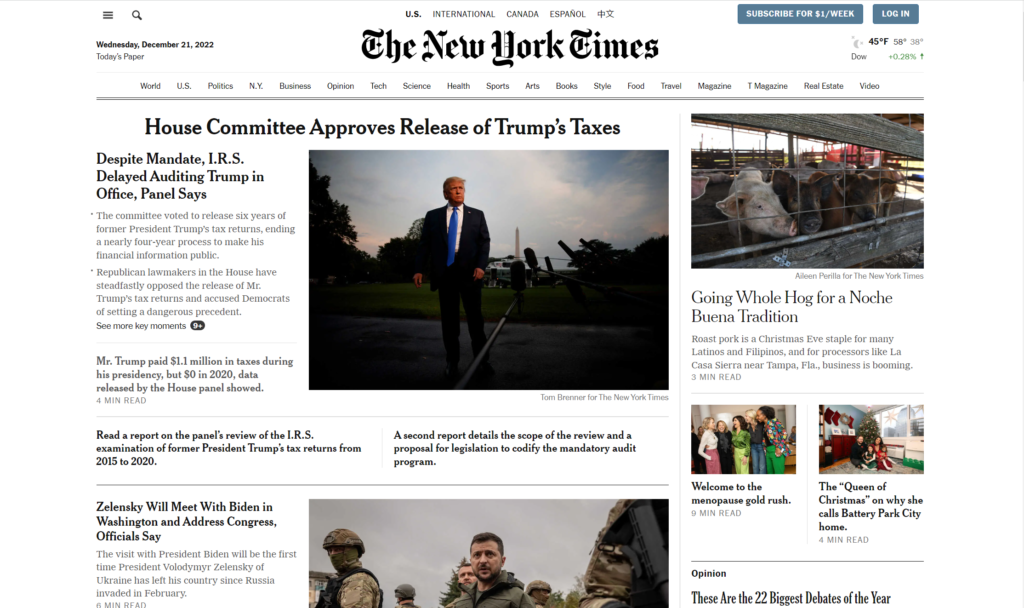
The New York Times (abbreviated as NYT or NY Times), is a New York-based American newspaper with a global reach and readership. The newspaper’s motto, “All the News That’s Fit to Print,” appears in the upper left corner of the front page. The New York Times was founded in 1851 and has won 130 Pulitzer Prizes.
Since 2008, The New York Times has been organized into the following sections: News, Editorial/Opinion Columns/Commentary, New York (Metropolitan), Business, Sports, Arts, Science, Fashion, Family, Travel and other features. The layout is classically serious and the editorials are written by many different writers and are free and open.
In terms of news coverage, The New York Times sees itself as a “newspaper record,” a policy that results in The New York Times rarely reporting an event first, except for local New York news. It is often used as a direct news source by other newspapers and news agencies around the world. It should be considered a model for the newspaper industry, from its operations to its content production, including its observation of social issues.
Subscription Price: Digital Edition: $221/Year for.
7. CNBC PRO
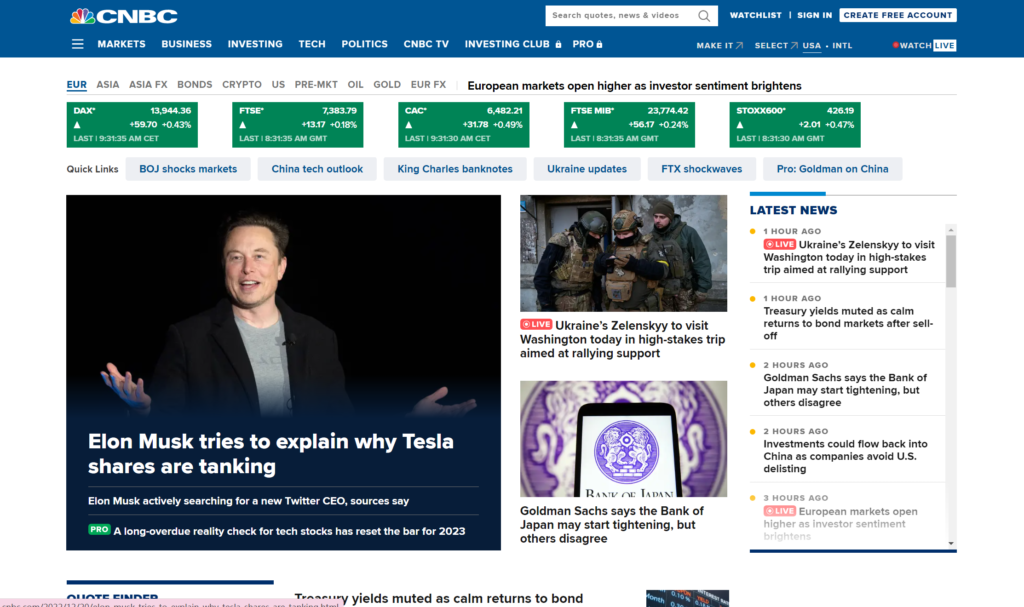
CNBC is an American pay television business news channel owned by NBCUniversal News Group, a division of NBCUniversal, with both indirectly owned by Comcast. Headquartered in Englewood Cliffs, New Jersey, the network primarily carries business day coverage of U.S. and international financial markets. Following the end of the business day and on non-trading days, CNBC primarily carries financial and business-themed documentaries and reality shows.
CNBC was established on April 17, 1989, as a joint venture between NBC and Cablevision as the Consumer News and Business Channel. Two years later, in 1991, the network acquired its main competitor, the Financial News Network, a move which expanded both its distribution and its workforce. Cablevision subsequently sold its stake to NBC, giving NBC sole ownership. As of February 2015, CNBC is available to approximately 93,623,000 pay television households (80.4% of households with television) in the United States. In 2007, the network was ranked as the 19th-most valuable cable channel in the United States, worth roughly $4 billion.
What Is CNBC Pro?
It’s a paid subscription service on CNBC.com and CNBC apps.
Inside CNBC Pro, you will get access to the following:
- Live CNBC TV from U.S., Europe, and Asia
- CNBC PRO News
- Street Calls (i.e. Wall Street’s analyst calls interpreted for you before the market opens)
- CNBC Pro Uncut (i.e. Interviews with fund managers, company CEOs and market experts)
- Follow the Pros (i.e. what top fund managers are buying or selling)
- Pros Talk (i.e. interviews with fund managers and prominent investors)
- A View From Top (i.e. interviews with company CEOs)
- Mike Santoli’s Notes on Stocks (i.e. daily notebook of Mike Santoli, CNBC’s senior markets commentator, with ideas about trends, stocks and market statistics)
- Stock Deep Dive (i.e. in-depth analysis on specific stocks)
Pros
- It offers you the CNBC news coverage of the Asian and European markets
- The newsletter spells out the major news stories of the day
- Gives you access to exclusive interviews by top market analysts and fund managers
- Offers you exclusive news stories
Cons
- It is a bit pricy
- You can access some of the content via CNBC TV
Subscription Price: Digital Edition: $299.99/Year Annual pay.
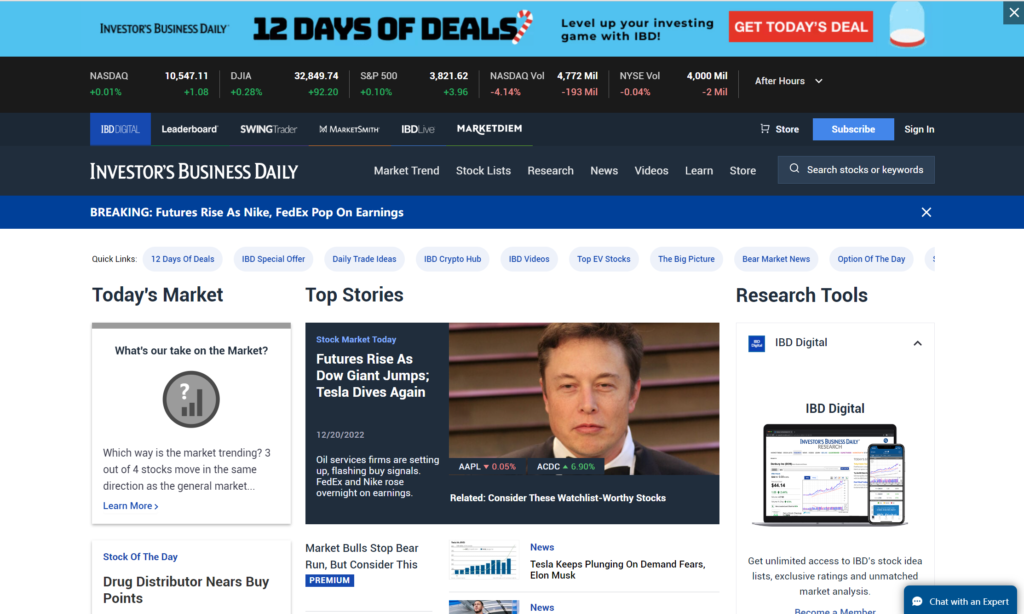
8. Investor’s Business Daily
Investor’s Business Daily (IBD) is an American newspaper and website covering the stock market, international business, finance and economics. Founded in 1984 by William O’Neil as a print news publication, it is owned by News Corp and is headquartered in Los Angeles, California.
The main IBD platform provides market-wide news and analysis, while the Leaderboard service applies CANSLIM to identify potential investments. IBD also offers several other premium services, including SwingTrader, MarketSmith, and IBD Live.
The IBD Digital helps you discover winning stocks through investors exclusive stock data compilation lists plus you are presented with proprietary ratings and insightful commentaries on fast-growing companies. You’ll find time-sensitive detailed data as well as pertinent fundamental and technical data arranged in an easily identifiable fashion.
Subscription Price: Digital Edition: $419.4/Year Annual pay.
9. Harvard Business Review
Founded in 1922, Harvard Business Review is a landmark publication of Harvard Business School; for 100 years, it has been dedicated to creating and disseminating the latest management ideas and methods to help business leaders renew and update their ideas. It is known as the “management bible”; HBR is the vehicle for the best management ideas.
Harvard Business Review Press is a leading global book publisher and a division of the Harvard Business Review Group. HBR Press publishes for the general, professional, and academic markets on the topics of leadership, strategy, innovation, and management.

Subscription Price: Digital Edition: $120/Year Annual pay.
10. Business Insider
Business Insider is an online business site focused on the financial, entertainment, green tech and digital industry verticals. The flagship vertical, Silicon Alley Insider, launched on July 19, 2007, led by DoubleClick founders Dwight Merriman and Kevin Ryan and former Wall Street analyst Henry Blodget.
Business Insider pioneered digital-native business news coverage and uses engaging, need-to-know storytelling to inform the new generation of leaders. Today, the brand becomes one of the largest business news sites in the world, covering everything its audience needs to know about business, tech, finance, and more.

Subscription Price: Digital Edition: $99/Year Annual pay.
Conclusion: Not all newspapers & magazines are 100% accurate, it is better to collect the information from different newspapers & magazines to summarize and analyse, so that you can make the right investing decision. But it will be too much to get the subscriptions to all of the newspapers & magazines, good news is that you can get access to all the websites above(except Investor’s Business Daily) and many other newspapers & magazines with affordable price. It is not subscription, just working on PC. I think it is good enough to collect the information.